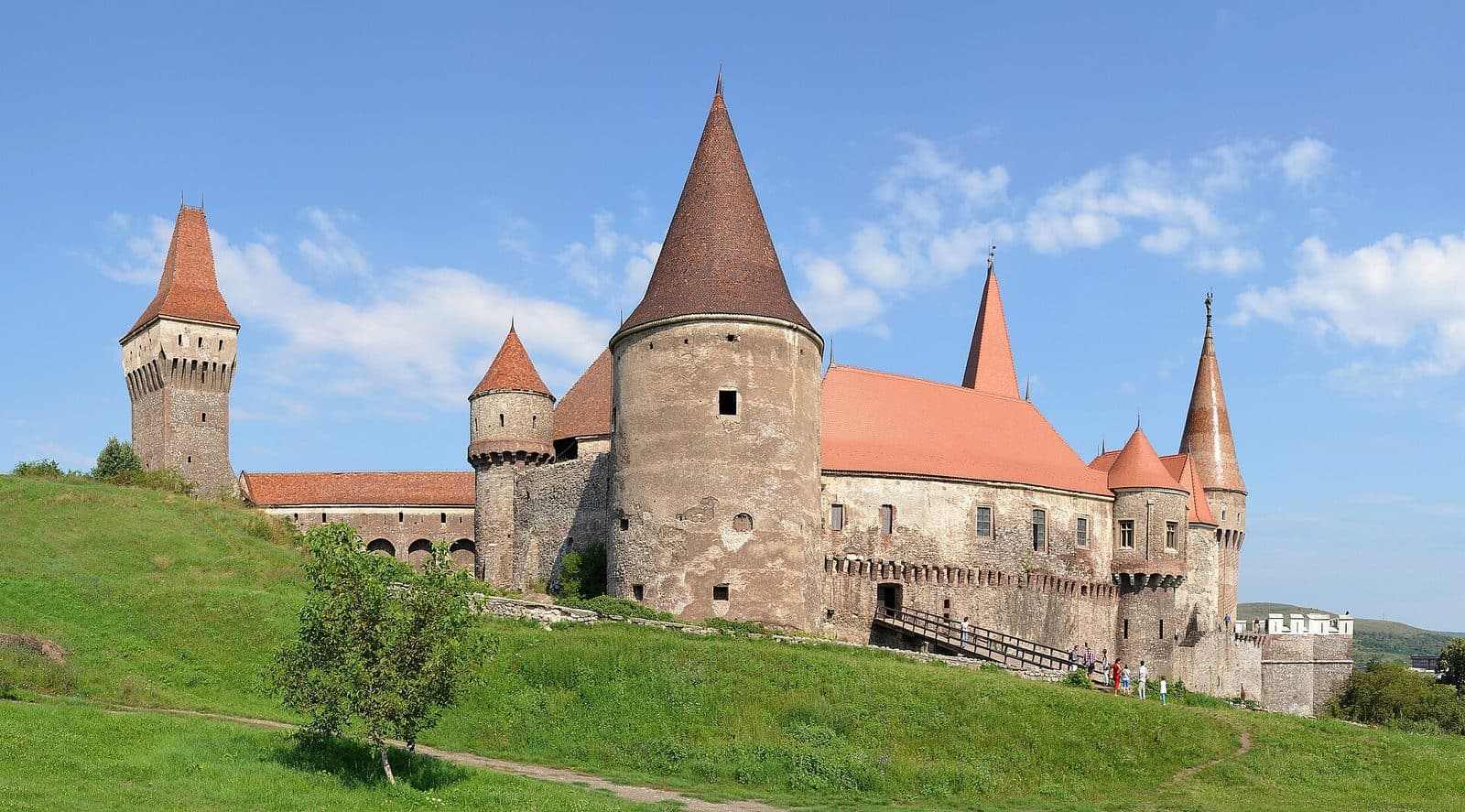
Corvin Castle: The Raven's Fortress Where Dracula Lost His Mind
A Gothic-Renaissance colossus in Transylvania, raised by a warlord, marked by a raven, and shadowed by legends of imprisonment and broken promises.
High on a crag above the little Zlasti River in Hunedoara, Corvin Castle rises like a fever dream of medieval Transylvania: drawbridge over a ravine, a thicket of spires and bastions, roofs in clashing colors, balconies carved with stone. Construction began in 1446 under John Hunyadi, the Voivode of Transylvania and warlord who beat back the Ottomans at Belgrade. He transformed an older keep into one of the largest castles in Europe, and after his death in 1456 his son, King Matthias Corvinus, crowned it with a Renaissance wing painted with the lives of nobles.
The family's emblem haunts the whole place: a black raven clutching a golden ring. Legend says a raven once snatched a ring from the young Hunyadi, who shot the bird down to recover it; from corvus, the Latin for raven, the dynasty took the name Corvinus. Whether true or a flourish invented by later chroniclers who linked the Hunyadis to an ancient Roman house, the bird is everywhere here, even minted onto the family's coins.
The castle's darkest tale belongs to Vlad III, Vlad the Impaler, the historical seed of Dracula. Tradition holds that he was thrown into Corvin's underground chambers and held for seven years, emerging unhinged, his cruelty sharpened by captivity. The truth is murkier: there is no document proving he was kept here at all. His long imprisonment by Matthias Corvinus is better attested at Visegrad in Hungary, not Hunedoara. The madness is pure legend, but it clings to these cold stone vaults like damp.
Then there is the well in the courtyard, sunk some thirty meters into solid rock. The story goes that three Turkish prisoners were promised their freedom if they dug down to water. They labored fifteen years, and when at last water came, the promise was broken. Folklore says one captive carved a bitter line into the stone: you have water, but no soul. Scholars who read the actual Arabic inscription found something quieter and just as sad: a man named Hasan, identifying himself as a slave in the fortress by the church.
By the 19th century the fortress had been gutted by fire and left to decay before restoration began. Today its theatrical Gothic silhouette has made it a favorite of filmmakers: it stood in as the cursed Abbey of St. Carta in the 2018 horror film The Nun, and has appeared in productions including Ghost Rider: Spirit of Vengeance and the 2024 Nosferatu. Few places wear their legends as convincingly as the raven's castle.
“You have water, but no soul.”
Curiosities & Legends
- 01John Hunyadi's last defensive keep is called the Neboisa Tower, from a Serbo-Croatian phrase meaning 'don't be afraid.'
- 02The Hunyadi dynasty stamped a raven holding a golden ring onto its coins, the heraldic source of the name Corvinus, from the Latin corvus for raven.
- 03Despite the popular '7 years a prisoner' tale, there is no historical document proving Vlad the Impaler was ever held at Corvin Castle; his documented captivity under Matthias Corvinus was largely at Visegrad in Hungary.
- 04The courtyard well, roughly 30 meters deep, was dug into bedrock; legend says Turkish prisoners spent about 15 years on it after being promised freedom that never came.
- 05The famous well inscription reading 'you have water, but no soul' is a legend; the actual Arabic carving names a captive called Hasan describing himself as a slave in the fortress.
- 06Corvin Castle played the haunted Abbey of St. Carta in the 2018 film The Nun, which grossed around 366 million dollars worldwide against a 22 million dollar budget.
Source & further reading: Wikipedia: Corvin Castle
Experience this place yourself — woven into your transformation journey.