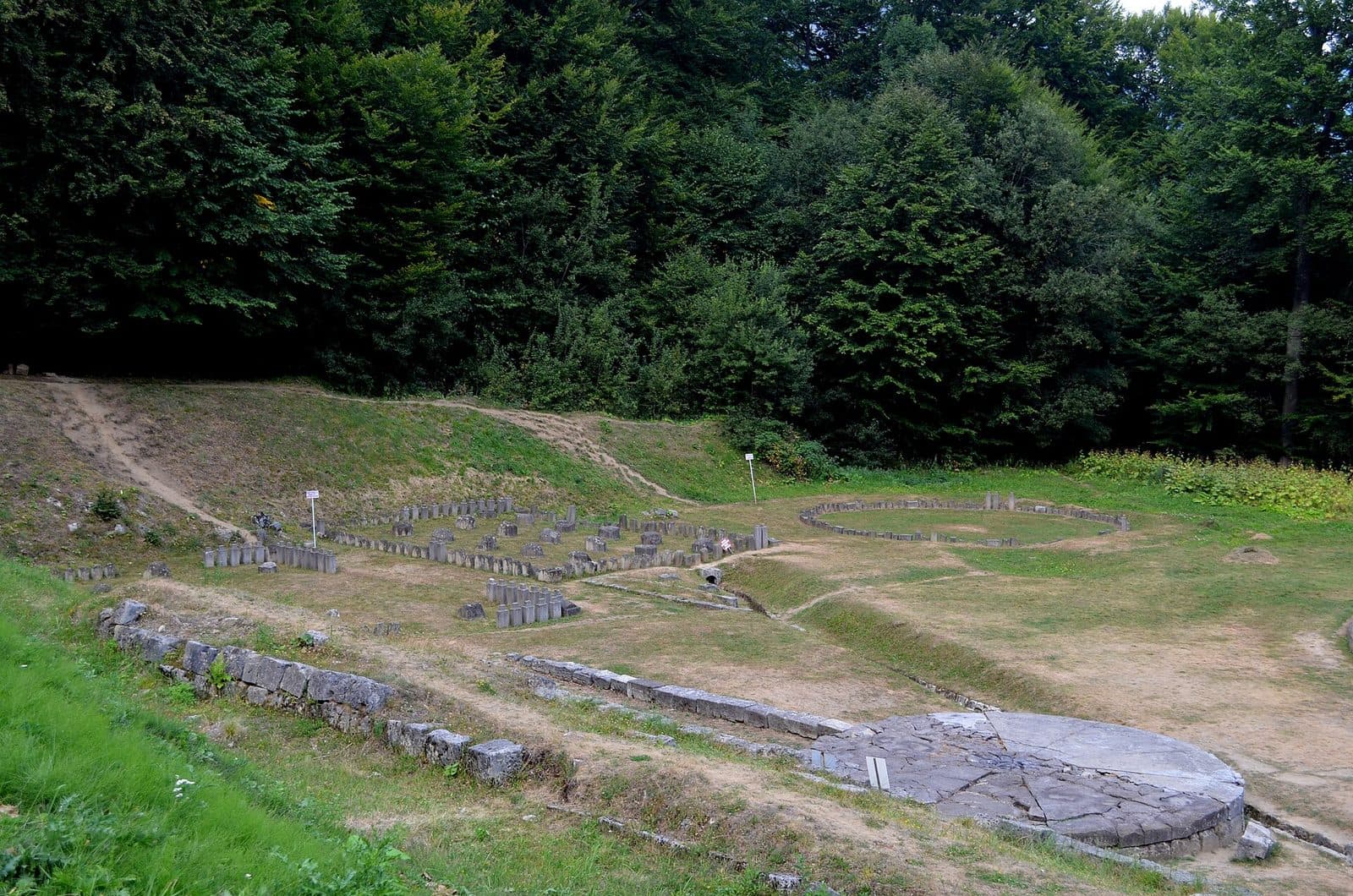
Sarmizegetusa Regia: The Mountain Where Kings Spoke to Gods
High in the beech forests of the Orăștie Mountains, Romania's "Stonehenge" guards the secrets of Zalmoxis, a defiant king's hidden gold, and a calendar carved in stone.
At over 1,000 metres in the Orăștie Mountains of Transylvania, a road winds through old beech forest to the ruins of Sarmizegetusa Regia, the capital of the ancient Dacian kingdom and, since 1999, a UNESCO World Heritage Site. This was no rough hill fort. Its walls were built in the famed murus dacicus technique, massive dressed stone blocks some three metres thick, and ceramic pipes carried running water to the houses of the nobility, a feat of mountain engineering two thousand years ago.
Beyond the citadel lies the sacred zone, the reason travellers call this place the Stonehenge of Romania. Its great circular sanctuary is ringed by exactly 104 andesite blocks enclosing settings of timber posts arranged in a D shape, and nearby rests the Andesite Sun, a stone disc 1.46 metres across extended by ten trapezoidal rays, each 2.76 metres long. Researchers believe the disc served as a sundial and that the sanctuaries encoded astronomical observations, possibly a Dacian calendar shaped by contact with Hellenistic geometry and astronomy.
The Dacians worshipped Zalmoxis, and the ancient sources tell his story with awe. Herodotus wrote that the Getae, ancestors of the Dacians, believed they did not die but went to their god, and that Zalmoxis vanished into an underground chamber for three years before reappearing as proof of life beyond death. Strabo placed his dwelling in a cave on Kogaionon, the holy mountain, whose true location is still debated: some scholars point to the Grădiștea hill of Sarmizegetusa itself, others to the 2,291-metre Gugu peak nearby.
The kingdom fell in blood. After Trajan's first war forced Decebalus to partly dismantle his walls in AD 102, the Dacian king rebuilt them in defiance, and in 106 the legions took and razed the capital. Decebalus took his own life rather than be paraded in Rome, a scene carved into Trajan's Column. Cassius Dio records that the king had diverted the river Sargetia to bury his treasure beneath its bed, killing the prisoners who dug the hiding place, only for a confidant named Bicilis to betray the secret to Rome. The victors built a new Roman capital, Ulpia Traiana Sarmizegetusa, some 40 kilometres away.
Yet the mountain kept part of its hoard. Between 1999 and 2001, treasure hunters looted twenty-four solid gold spiral bracelets from the site, each cold-hammered from a single ingot of native Transylvanian gold and finished with serpent-head terminals. They were smuggled to collectors across Europe and America, and one even passed through Christie's New York in December 1999. Romanian investigators have since recovered thirteen of them, about 12.5 kilograms of royal gold now displayed at the National Museum of Romanian History in Bucharest. Eleven bracelets are still out there, somewhere, and the forest above Sarmizegetusa gives nothing away.
“"They believe that they do not die, but that he who perishes goes to the god Zalmoxis." — Herodotus, on the ancestors of the Dacians”
Curiosities & Legends
- 01The great circular sanctuary is ringed by exactly 104 andesite blocks, an arrangement scholars believe had calendrical meaning for the Dacians.
- 02The Andesite Sun is a stone disc with a 1.46-metre core and ten trapezoidal rays each 2.76 metres long, and researchers think it worked as a sundial.
- 03Ceramic pipes brought running water to noble residences at over 1,000 metres altitude, two millennia before modern plumbing reached these mountains.
- 04Cassius Dio wrote that King Decebalus diverted the Sargetia river to bury his treasure beneath the riverbed, a hiding place betrayed to Trajan by the captured nobleman Bicilis.
- 05Of 24 gold spiral bracelets looted from the site between 1999 and 2001, each weighing up to 1.2 kilograms, Romania has recovered 13; one had been sold at Christie's New York in December 1999.
- 06Laboratory analysis of the recovered bracelets showed they were hammered from natural, unrefined Transylvanian gold, matching the region's ore and confirming their authenticity after years of doubt.
Source & further reading: UNESCO World Heritage Centre — Dacian Fortresses of the Orăștie Mountains
Experience this place yourself — woven into your transformation journey.