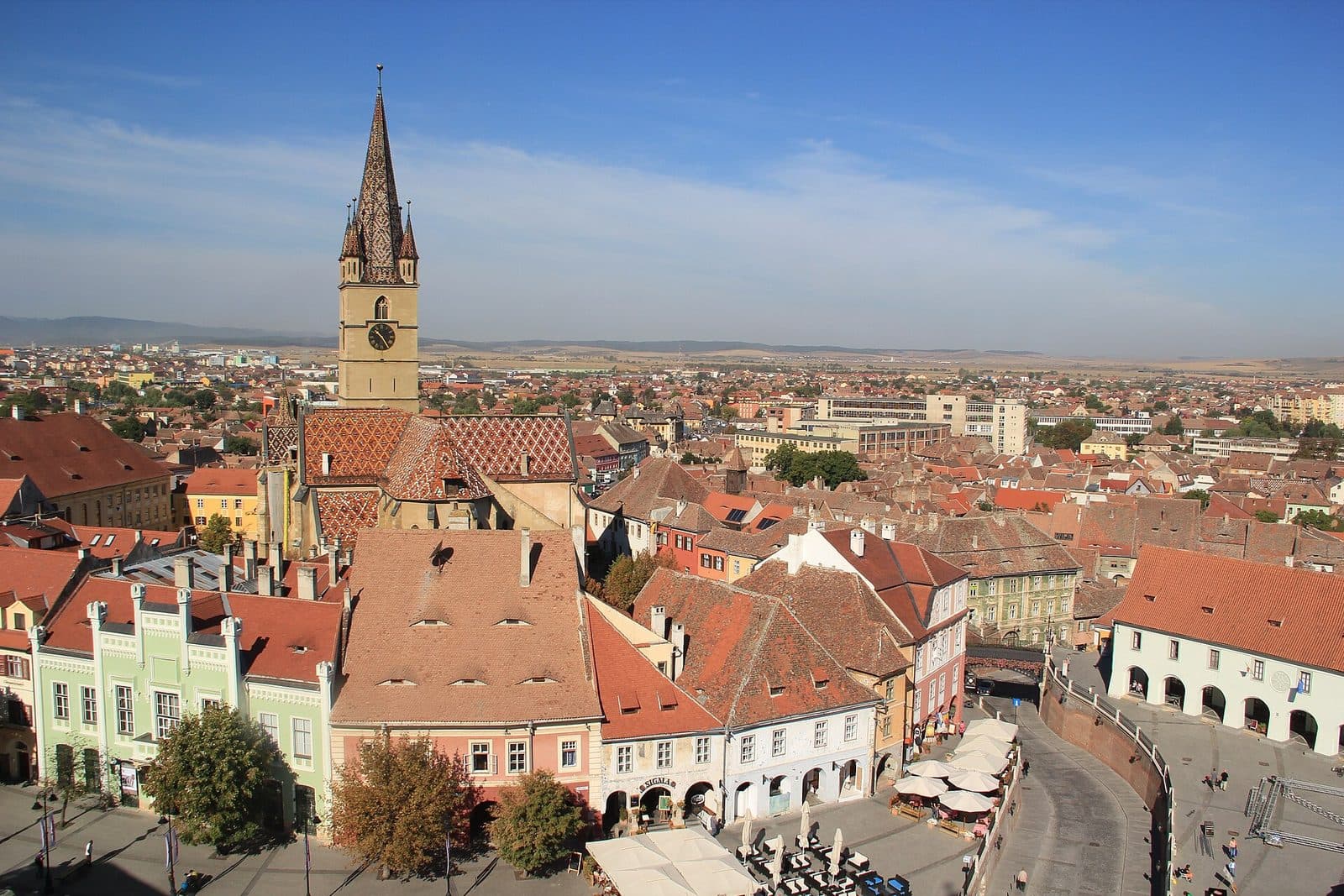
The City That Watches: Sibiu's Eyes, Lies and Iron
In Transylvania's old Saxon capital, eyelid-shaped windows stare down from the rooftops — and a cast-iron bridge is said to groan the moment you tell a lie on it.
Walk into Sibiu's old town and you will feel it almost immediately: the rooftops are looking at you. Narrow dormer windows, curved like half-lowered eyelids, blink from the tiled roofs of houses that have stood since the Middle Ages. Built to ventilate the attics where burghers stored their grain, these "eyes of the city" have become Sibiu's most uncanny signature — a whole skyline that seems to keep watch. The Saxons who built it arrived around 1147, invited by Hungary's King Géza II, and the settlement was first recorded as Cibinium in a papal document of 1191. As Hermannstadt, it grew into the proud chief city of the Transylvanian Saxons, ringed by walls and guarded by the Council Tower, which over the centuries served as grain store, fire watchtower, temporary prison and even a botany museum.
In the Small Square, a graceful span of cast iron crosses Ocnei Street: the Bridge of Lies, Podul Minciunilor. Cast in 1859 by the German foundry Friedrichshütte, it was the first cast-iron bridge in what is now Romania — and the most distrusted. Legend insists the bridge has ears and an unforgiving temper: tell a lie while standing on it and it will creak at every joint; tell one big enough and it will collapse beneath you. Older tales say cheating merchants were thrown from it, and that military cadets who whispered false promises to sweethearts here met the same fate. The truth may be a pun: the German name Lügenbrücke (bridge of lies) likely evolved from Liegenbrücke — the "lying-down" bridge, the one resting on no support pillars. The legend, locals will tell you, is far too good to surrender to etymology.
A few steps away stands the baroque palace of Baron Samuel von Brukenthal, the Habsburg governor of Transylvania, whose art collection opened to the public in 1817 — making the Brukenthal the oldest museum in modern Romania, receiving visitors seven years before London's National Gallery. Its galleries hold roughly 1,200 European paintings from the 15th to 18th centuries, and one genuine mystery: on a May night in 1968, thieves lifted eight masterpieces from its walls. Four, including Titian's Ecce Homo, resurfaced three decades later in the United States and were recovered with Interpol's help in 1998. Four more, among them a Van Dyck, are still missing.
Sibiu's archives guard an even stranger secret. The Sibiu Manuscript, rediscovered there in 1961, contains the 16th-century writings of artillery master Conrad Haas — including descriptions and drawings of multi-stage rockets, delta fins and bell-shaped nozzles, set down some four hundred years before such rockets ever flew. The city's modern chapter is no less remarkable: in 2007, the very year Romania joined the European Union, Sibiu served as European Capital of Culture alongside Luxembourg City, and in 2008 Forbes ranked it Europe's eighth most idyllic place to live. The houses, of course, saw it all coming. They have been watching for eight hundred years.
“Tell a lie on the bridge, the legend warns, and you will hear it groan at every joint beneath your feet.”
Curiosities & Legends
- 01The Bridge of Lies (1859) was Romania's first cast-iron bridge — and its German name Lügenbrücke probably began as Liegenbrücke, the "lying-down bridge", before legend turned the pun into a lie detector.
- 02Local lore claims the bridge creaks at every falsehood spoken on it, and that dishonest merchants and oath-breaking cadets were once hurled over its railings.
- 03The Brukenthal Museum opened to the public in 1817, seven years before London's National Gallery, making it the oldest museum on Romanian territory.
- 04In May 1968, eight paintings were stolen from the Brukenthal; four — including Titian's Ecce Homo — were recovered via Interpol in 1998 after surfacing in America, while four are still missing today.
- 05The Sibiu Manuscript, found in the city archives in 1961, shows that local artillery master Conrad Haas described multi-stage rockets in the mid-1500s — roughly four centuries before one ever flew.
- 06In 2008 Forbes named Sibiu Europe's 8th most idyllic place to live, a year after it became European Capital of Culture (with Luxembourg City) — in the same year Romania joined the EU.
Source & further reading: Wikipedia — Sibiu (with Bridge of Lies, Brukenthal National Museum, Council Tower of Sibiu and Conrad Haas entries)
Experience this place yourself — woven into your transformation journey.